Chapter Outline - Study Guide p.11
Important paragraph that sets the tone that course is not simply about Renaissance artists recovering the excellence of the antique (i.e. Greek and Roman 5th CBE - 2nd CE) nor is it about the notion that the development of naturalistic art simply copied the antique.
Course Book 1 - Making Renaissance Art
1) Vasari and the Italian Renaissance
Vasari wrote Lives of Artists which has dictated the way we view the Renaissance and Florence. Although his claims will be considered, his writings will not set the agenda for the course. Not just Florence but other Italian and European art and artists are discussed.
2) The Revival of the Antique
From the universities that were developing in the new urban centres in Italy there came the humanists, followers of the teachings and thinking of Petrarch, based on ancient manuscripts. Many humanists became holders of influential positions and tutors to the children of the aristocracy, thus spreading Petrarch's ideas.
Drawing on works such as Donatello's David, Van Eyck's Virgin and Child at the Fountain, and Nanni di Banco's Four Crowned Saints, the point is made that their work was not just a copying of the ancient art of Greece and Rome, but that they did incorporate some of its naturalistic styles into the work. Also ancient references could add cachet to their work i.e. Greek and Latin inscriptions.
3) Imitating Nature
Works of art were not exclusively life-like, artists continued to produce work in the Greek style as can be seen in Van Eyck's Virgin and Child at the Fountain.
Conclusion
Sums up introduction by observing that there are many approaches to the 'making' of art that will be covered in this book.
Introduction of Art in Renaissance Italy written by Evelyn Welch.
Renaissance was a description meaning 're-birth' introduced by Jacob Burckhart (1818 - 97) (a northern European historian) which was used to describe what he saw as a 15/16th century episode which formed the crucial moment when ideals such as 'individualism, nationalism, secularism and capitalist entrepreneuralism were born and then transmitted to the rest of the western world' (Welch p.9). This idea tends to focus on the progression of artistic styles particularly within Tuscany. Vasari's work Lives of the Artists certainly contributes to this notion, but it 'transforms the earlier centuries in Italian art into ante-rooms for the 16th Century' (Welch p.11).
In the 1970's British art historian Michael Baxandall 'popularised the concept of the 'period eye' the immediate social and visual context in which pictures were both created and observed'. (Welch p.22)
This introduction reviews the history of the Italian peninsular and its various city states particularly, and also the wider influence that came to bear upon them from other parts of Europe and from the Ottoman rule in Constantinople. It identifies not just the differences and divisions, but also the unifying features that ran across the peninsular e.g. religious belief, moral and patrician traditions. It also covers the development and networking of academics, particularly humanists following the writings of Petrarch. All of this is presented so as to enable the reader to take a more informed view and to be better able to use the 'period eye' when looking at and considering the art of the period and particularly the Renaissance. It suggests that the explanations for Renaissance art are far more diverse than the rather neat and simplistic views that have been traditionally put forward.
The Northern Renaissance - Jeffrey Chips Smith
Introduction.
This introduction sets the scene in historical terms and begins to examine what the term ‘Renaissance’ might signify in northern Europe.
Wednesday, 16 January 2008

Monday, 14 January 2008
Monday, 7 January 2008
Viewing Renaissance Art - Chapter 6
Art and Death
Introduction
This chapter explores the relationship between art works, artifacts, religious donations and sponsorship, and death during the Renaissance. Widespread belief suggested that the soul spent time in purgatory before going to heaven, and many of the items mentioned are to remind the living to pray for the dead and shorten their time in purgatory. However, the same items also ensure a lasting reputation of the dead amongst the living.
1.Memorials, morals and the macabre.
This section features the tomb at Ewelme, Oxfordshire of Alice de la Pole (1404-76) (Pl.6.3 p.211, Pl 6.4 p.212 and Pl6.5 p.213) and how the effigies and style represent her piety, her patronage so that she will be remembered and prayed for, and her politics.
 2. The fine arts of dying well
Ars moriendi
An early printed book The Art of Dying was popular during the 1400's and early 1500's. It consists of prints showing a dying man preparing for death and triumphant over temptation. (Pl.6.7 p.215)
Danse macabre -a series of paintings and verses which appeared in numerous forms such as on the walls of cloisters or as privately owned printed books, which emphasized the equality of all from peasant to king or queen, in the face of death. The purpose was to emphasize that all should be ready and to live a good life. Examples : 30 metre cloth painting (Pl.6.8 and Pl.6.9 p.216) and parchment manuscript (Pl.6.10 p..217)  Popular Prints - Portable prints for display within the home or for private use to remind the owner to live a good life. Examples (Pl6.11 p.219) and artistically note-worthy those by Albrecht Durer (1471-1528) Knight, Death and the Devil (Pl.6.12 p.220) This is one of the trio of works which included St. Jerome in His Study and Melancholia I
Hospitals - This features two altar-pieces from hospitals in Northern Europe. They carry out a duel role as reminders of mortality and the need to seek salvation for those in the hospital, and as memorials to those who as part of their good works donated to the hospitals. Pl.6.13 p.221 Roger Van Weyden Last Judgement (altar piece closed), Pl.6.14 p.222 (altar piece open). Pl.6.15 p.223 and Pl.6.16 p.224 are of the Isenheim altarpiece by Matthias Grunewald.
3. The Italian triumph over death
Cardinals Monuments - a very tedious section on the tombs of cardinals!
Three exceptional tombs in Rome
Consideration is given to three outstanding tombs and their design and completion. What is notable in all is that they highlight the office held by the dead man as much as the individual themselves, and so commemorate and promote the institutions as well as reminding the viewer of the deceased.
The three tombs are of Pope Julius II which was originally to be a huge scale project but which was eventually reduced to a wall memorial. From the -project the sculptures of Michelangelo's slaves are now in the Louvre. The second tomb is that of Pope Sixtus IV (Pl.6.24 p.234) cast in bronze it is now situated in the sacristy museum of St.Peters. The third tomb (Pl.6.25 p.235) shows the tomb of Cardinal Ascanio Sforza which shows the influence of Portuguese tombs particularly the way in which the effigy is shown as reclining as if asleep rather than dead.
4.Dynastic Monuments
Ferdinand and Isabella
This section discusses the way in which the Spanish royal family chose first of all a Flemish sculptor to produce the tombs of JuanII and Isabella of Portugal (Pl.6.26 p.237) and Italian artists for those of Ferdinand and Isabella (Pl.6.28 p.239 and Pl.6.29 p.240). Royal tombs are very much about political statements emphasizing the lineage, pedigree and alliances of state and church.
Maximillian I - designed his tomb as a huge statement of his lineage and dynastic pedigree, the plan incorporating 100 statues of relatives, ancestors, Roman emperors, saints, and even mythical figures with whom he aligned himself and his family emphasizing the continuity between the living and the dead, as a statement of his own importance. Pl.6.31 p.242 and Pl.6.32 p.243 show the tomb and some of the figures. Pl.6.33 p.244 shows a woodcut -print by a pupil of Albrecht Durer showing the deceased Maximillian being presented to God in heaven by no fewer than six of his patron saints and the Virgin and Child.
Being remembered, prayed for and acknowledged as part of this historical group was important, but this continuity between the living and the dead was soon to lose its importance as some of the fundamental belief structures became dismantled with the rise of Luther against the power of the Church of Rome.
Conclusion - written by Carol M. Richardson (author of this chapter)
Commemorative monuments, manuscripts and paintings reveal some of the complex beliefs and coping strategies adopted by the living to deal with the problem of death. They are among the most vivid examples of the different ways that works of art are used. They make it clear that the preparation of the living for death and the belief in the after-life were an integral part of religious devotion. Through appropriate commemoration of relatives, ensuring the continuation of one's own memory and the demonstration of good deeds displayed in so many works of art, time in purgatory might even be curtailed.
All that quickly changed. Although at first he sought only to reform the concept of purgatory, by 1530 Martin Luther had completely rejected its existence. Intercession for souls in purgatory had taken over from the Mass, which Luther complained was 'held mostly for the dead, although it was given and instituted as a consolation only for living Christians'. Luther instead envisaged death as a sleep, a dream state in which the dead awaited the Last Judgement and where they could not be reached by the living. John Frith in England argued that purgatory was no more than a way for the Church to exact money from the faithful: 'this their painful purgatory was but a vain imagination, and that it hath for a long time but deceived the people, and milked them from their money'. Whereas previously the funeral had served as only the beginning of a long process of prayer for the soul to aid its desperate plight through purgatory, by the middle of the sixteenth century north of the Alps the funeral had become the point at which the end of life was regretted, loss of the individual mourned and the corpse disposed of. It was a point of departure over which the living had no control or means of influence. Monuments commemorated life past;they did not remind the living to keep on remembering the dead. The commemorative arts of Protestant and Catholic Europe were set to follow separate paths.
Saturday, 5 January 2008
Viewing Renaissance Art Chapter 2
Introduction - Chapter 2
Refers us to the notion of magnificence as proposed by Aristotle and the way in which wealthy patrons sponsored works not only for their own enjoyment but for the public good. Also how guilds and confraternities even those associated with the lower social classes might raise money to commission work for their own religious purposes and the edification of the general public.
Florentine art and the public good.
Jill Burke introduces the notion of art in Florence and the public good. This chapter will investigate the tradition of Florentine pride in the visual arts that influenced Vasari's collection of artists biographies. Vasari, however, wrote his Lives during the time that Florence was ruled by the Medici's and he writes in a manner that suggests that the patronage of the elite was the main factor and that the art was primarily intended for the elite. This chapter also concentrates on the large amount of art and architecture that was instigated by Guilds, Confraternitites and the Republic to serve their various interests, the common good and promote pride in the city.
1. 'Firenze bella'
This section relates to the way in which Florence was governed for the public good by committees and bodies that were primarily borne out of the various merchant guilds. This ensured that no one family or guild was able to dominate the city and its governance for their own ends, and ensured the principle of commune and republic. The building and development of the city was controlled so as to reinforce the shared pride in the city. This period ran from late 1200's through to the early 1500's.
2. Magnificence and the Medici's
This section covers the rise of the Medici family and once again demonstrates how the idea of 'magnificence' i.e. the spending by an individual or a family on projects for the common good of the city, the populace or the church was a well accepted and encouraged act. Several specific art works are discussed notably Pl.2.15 p.70 Andrea del Verrocchio Christ and Saint Thomas Pl2.8 p.65 Donatello David Pl.2.9 p.65 Donatello Judith and Holofernes and Pl.2.16 p.72 Domenico Ghirlandaio, Annunciation to Zachariah.
3. Magnificence Contested
The Medici family eventually came to establish an hereditary duchy in Florence, but this was often contested and resented as being an erosion of liberty and republican virtues, although it was a period of prosperity for the city. On three occasions the Medici's were exiled. Their opponents contested the idea of 'magnificence', seeing such spending as only benefiting and promoting the interests of themselves and their family. A leading critic Savonarola came to prominence preaching against such extravagances and promoting extreme piety. He was executed for false prophecy in 1498.
4. Communal Patronage in the Service of the Republic
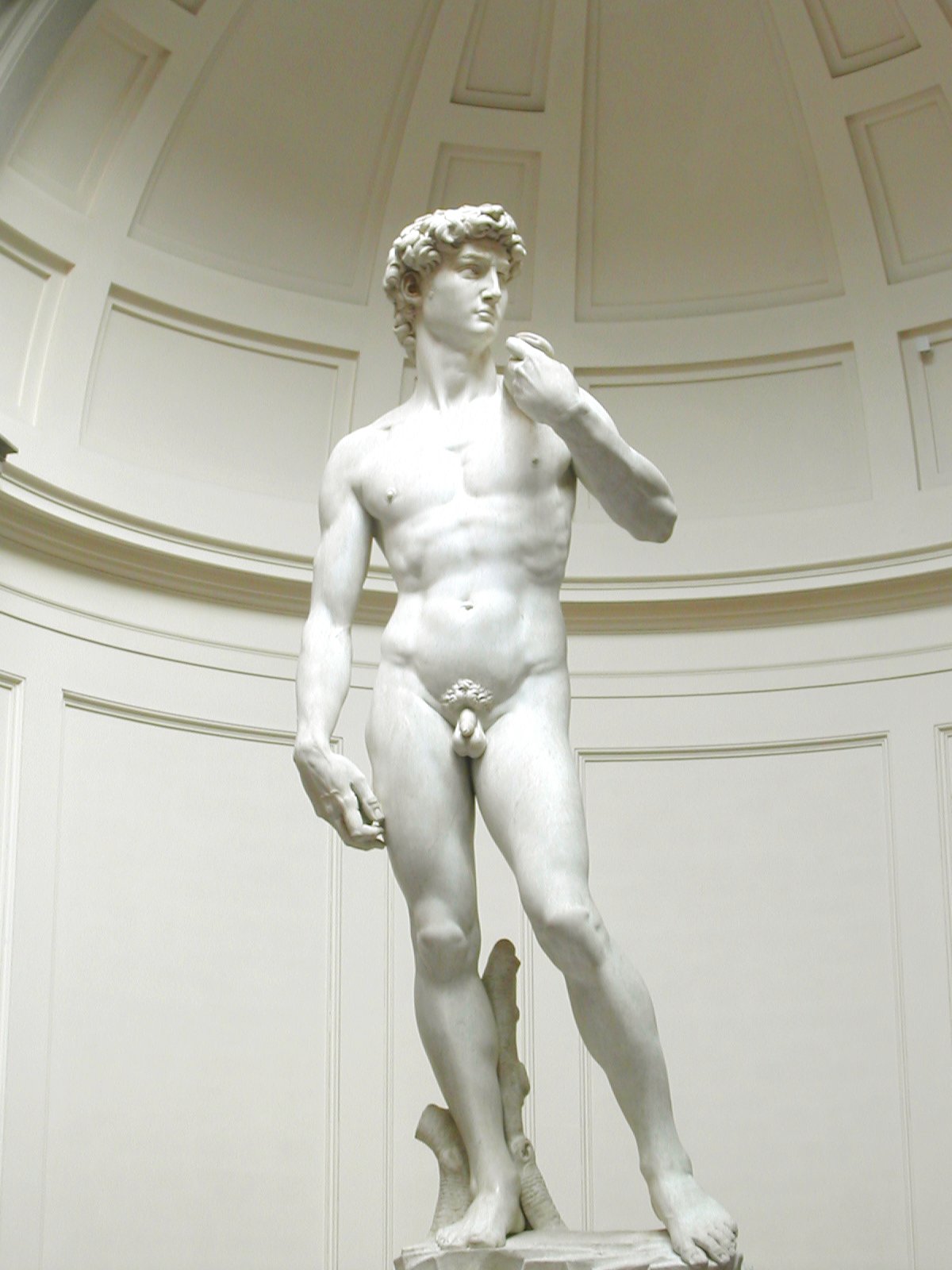
Between Savonarola's execution in 1498 and the return of the Medici's in 1512, there was a resurgence of the republic. Works commissioned during this time included paintings in the Sala dei Cinquecento by Leonardo da Vinci and Michelangelo which were never finished. Pl.2.19 p.77 illustrate copies as the originals were painted over. Above the north doors of the Baptistery, John the Baptist preaching to a Levite and Pharisee (Pl.2.21 p.78)were commissioned and executed by Giovanfrancesco Rustici, which appeared to reflect the earlier works of Donatello (Pl.2.22 and Pl.2.23 p.79) harking back to the pre-magnificence styles. The most outstanding work of this period is Michelangelo's David completed in 1504 and subsequently erected in the Palazzo della Signoriam to evoke the ideals of the republic.
5 Artisans and Workers
This section reports how even the most unskilled and poorest of workers could have and did purchase religious imagery for their own homes, and how even relatively modest craftsmen would purchase tombs or donate artworks in churches. Also is recorded some comparative values between earnings of Florentine workers and those in Britain today.
6. Confraternities and the Visual Arts
Individuals who would have no way of being able to afford or sponsor works of art or events were given the opportunity to participate through membership of confraternities. Groupings either by trade or age or geographical location, such as an area of the city. These confraternities gave a community identity that provided support for their members. Particular reference is made of the carders, the semi-skilled workers who cleaned the wool cloth before it went to be dyed (p.85) and their various activities including regular masses, processions, and religious enacted drama's, all of which were seen as contributing to the cultural and religious life of the city in the same way as the sponsorship of works of art by the much more wealthy guilds or individuals.
7. Corporate Patronage and Empowerment
As well as the confraternities there was one type of organisation that seems to have represented the lower classes the potenze (literally the powers) which staged festivals, processions etc at holiday periods and seems to have represented its group as required throughout the year. Florence was divided into areas or kingdoms, markers of their districts can be seen on page 87 pl.2.28 and 2.29. Particular note is made of a street tabernacle commissioned by the potenze kingdom of Bethlehem (Pl.2.30 p.88) a ceramic portrayal of the Virgin, Jesus and various saints. Erected probably to give thanks for survival of the plague this public work of art would have been paid for by the poorest in society.
8. Conclusion
This chapter suggests that Vasari takes away the social and political reasons for the creation of much of the art and artifacts of the Renaissance, and instead attributes them solely to the creation of the genius artist and the educated benefactor. In reality Michelangelo's David was created as a reminder of Florence's republican position and an inspiration to its citizens to maintain this.
Tuesday, 4 December 2007
Viewing Renaissance Art
Introduction
Important that art is viewed with the 'period eye' which encompasses, cultural, religious, political and status of the time.
1. Renaissance art, prestige and social class.
A 'crucial tool' of the time was the writings of Aristotle who offered a sort of social code of expenditure which he called 'magnificence'. (p.14) The concept of magnificence is a 'crucial tool' for us in understanding the way in which Renaissance art is viewed. Within all societies there were boundaries to the amount of expenditure and 'show' that an individual could make, according to their social status e.g. the sumptury laws. For the Medici family their public expression required some caution, whilst in private they would go to excess.
2. Viewing religious art in the Renaissance period.
Privatisation of the church describes the increasing expenditure of lay people on religious art, artifacts, buildings e.g. chapels, chancery's, tombs etc. This must be considered in the light of the 'period eye' and of the religious hold on everyday life including the fear of purgatory. There were divisions within Europe as to the way in which religious art should be viewed treated or regarded. These range from the Protestants view that they were just paint and canvas that detracted from worship, and the iconoclasm which saw the destruction of many works during the Reformation, to the Western Catholic view that the works aided meditation and had a didactic role, to those who considered icons to have miraculous powers in themselves.
Conclusion
This introduction highlights the necessity to view art and objects in the context of the time, society, and the culture in which they were produced. The book seeks to build a bridge between our viewing and that of a Renaissance person.
Chapter 1 - Art, Class and Wealth. Rembrant Duits
Introduction
The following chapter seeks to examine Renaissance art as material possession and commodity, and how its ownership permeated every level of society.
1. Catchphrases and concepts.
We are introduced to a number of expressions used by art historians in relation to the Renaissance particularly to the role of patrons. 'Conspicuous waste' and 'conspicuous consumption' were phrases coined by the American economist Thorstein Veblan a follower of Kal Marx. 'Conspicuous waste' refers to the deliberately excessive use of resources e.g. time, labour, money, goods to signify wealth and to keep others from gaining access to the same resources. (Story of Agostino Chigi throwing silver tableware into the Tiber after a banquet. However, this was an act and silverware was retrieved next day having been caught in a net!).
'Conspicuous consumption' refers to the acquisition of commodities beyond the purchasers elementary needs e.g. Chigi's construction of a pleasure villa. He argues that the leisure classes cultivated a certain fastidiousness however, regarding the luxury goods they invested in. It was as much about displaying taste as it was about displaying wealth. They calculated their 'kind' in the distinction between 'right' and 'wrong' in the display of wealth and social status. Adhere to the established pattern and you manifest a sense of class, deviate from it and you expose yourself as a parvenu (dictionary definition - a person who, having risen socially or economically, is considered to be an upstart) with money but no taste.
The expression 'material culture' originates in the field of anthropology where it stands for all material aspects of human civilisation. Its use by historians of Renaissance art is to help them circumvent questions of the artistic status of artifacts raised by the way we view art in our own time. 'Nowadays we are quite used to distinguish between Art with a capital A and the decorative or applied arts' (artisan and craft work) 'the former (Art) a profound emotional and intellectual medium for communication'. For example engaging in Rothko's Seagram murals is art with a capital A, whereas going to the jewellers is the decorative or applied arts. So the idea of 'material culture' embraces all of these items that may have been owned or collected by the Renaissance patron without having to put today's status on the objects.
maiolica = a variant of majolica
maiolica - noun - highly decorated earthenware with a glaze of tin oxide
majolica = –noun 1.Italian earthenware covered with an opaque glaze of tin oxide and usually highly decorated. 2. any earthenware having an opaque glaze of tin oxide.
2. The Working Classes
The working class which represented about 95% of the population earned very little and unlike many of the representations of them in art, were poorly and drably dressed. However, there was opportunity to take part in pilgrimages and to purchase or acquire Pilgrims badges such as scallop shells from Santiago da Compestela and Veronica in St. Peter's in the Vatican. The ownership and wearing of which displayed both status and offered the opportunity to shape a more interesting identity for themselves. This section included pictures from Sodoma (1477-1549) (plate 1.4 Saint Benedict Appears in a Dream of Two Monks and Gives Then the Plan for a New Monastery 1505-08 fresco with added tempera) and the Netherlandish artist Lucas Van Leyden (c.1494-1533) (plate 1.6 The Pilgrims 1508, engraving).
3. Artisans
The section on artisans is based around Petrus Christus (c.1410-75/76) Portrait of a Goldsmith (Willem van Vlueten?), 1449 oil on panel (Plate 1.8) and The Master of Frankfurt Portrait of the Artist and his Wife, 1496 oil on panel (Plate 1.9) Both of which project the image of the artisans through displays of owned objects, cloths, suggested patrons and in the case of the artist a display of his artistic skills. Artisans earned considerably more than workmen such as bricklayers and their enhanced social status allowed them more opportunity for 'conspicuous consumption'.
4. Doctors
Once again this section talks of the ways in which through depiction in portraits doctors showed their status, wealth, pride and claims of proficiency. As in the previous sections comparisons are made as to the earnings of doctors compared to labourers and masons etc. Special mention is made of the value of gold brocade and how this was simulated by painting on a four poster bed. This section concluded by referring to portraits struck on bronze medals, far more expensive than painting and an even more pretentious claim to status and display of wealth. (Plate1.13).
5. Entrepreneurs
This section reviews the material culture of self made merchants and their sponsorship and purchase of works of art such as the Primavera, and church frescoes as memorials and funerary chapels such as The Sassetti Chapel in Santa Trinita, Florence. The actual worth and value of their possessions is discussed often comparing the value of the work of art against other possessions which at the time were seen to have a higher worth noted in florins and ducats.
6. Women
Women as such are not highly regarded or recorded as patrons, particularly of printing, architecture and sculpture. It is likely however, that they were patrons and commissioners of works such as jewelry, manuscript and tapestry. The role of the woman within the material culture was almost akin to a possession and were often seen as objects of 'conspicuous consumption' showing off their husbands and male relations status and wealth.
7. Bankers and Collections
Here we read of the merchants and entrepreneurs who as well as investing in businesses themselves such as silk production, also entered the world of banking, providing loans to third parties and charging interest. They became extremely wealthy, the most well known being the Medici's in Florence. This wealth allowed them to indulge in 'conspicuous consumption' in the purchase of items of no practical use e.g. Tazza Farnese (pl 1.19 p.43) Illustrated above. The competition for these items increased their value, and their display in the homes and studies of their owners was part displaying status and identity, and part identity creation itself.
Important that art is viewed with the 'period eye' which encompasses, cultural, religious, political and status of the time.
1. Renaissance art, prestige and social class.
A 'crucial tool' of the time was the writings of Aristotle who offered a sort of social code of expenditure which he called 'magnificence'. (p.14) The concept of magnificence is a 'crucial tool' for us in understanding the way in which Renaissance art is viewed. Within all societies there were boundaries to the amount of expenditure and 'show' that an individual could make, according to their social status e.g. the sumptury laws. For the Medici family their public expression required some caution, whilst in private they would go to excess.
2. Viewing religious art in the Renaissance period.
Privatisation of the church describes the increasing expenditure of lay people on religious art, artifacts, buildings e.g. chapels, chancery's, tombs etc. This must be considered in the light of the 'period eye' and of the religious hold on everyday life including the fear of purgatory. There were divisions within Europe as to the way in which religious art should be viewed treated or regarded. These range from the Protestants view that they were just paint and canvas that detracted from worship, and the iconoclasm which saw the destruction of many works during the Reformation, to the Western Catholic view that the works aided meditation and had a didactic role, to those who considered icons to have miraculous powers in themselves.
Conclusion
This introduction highlights the necessity to view art and objects in the context of the time, society, and the culture in which they were produced. The book seeks to build a bridge between our viewing and that of a Renaissance person.
Chapter 1 - Art, Class and Wealth. Rembrant Duits
Introduction
The following chapter seeks to examine Renaissance art as material possession and commodity, and how its ownership permeated every level of society.
1. Catchphrases and concepts.
We are introduced to a number of expressions used by art historians in relation to the Renaissance particularly to the role of patrons. 'Conspicuous waste' and 'conspicuous consumption' were phrases coined by the American economist Thorstein Veblan a follower of Kal Marx. 'Conspicuous waste' refers to the deliberately excessive use of resources e.g. time, labour, money, goods to signify wealth and to keep others from gaining access to the same resources. (Story of Agostino Chigi throwing silver tableware into the Tiber after a banquet. However, this was an act and silverware was retrieved next day having been caught in a net!).
'Conspicuous consumption' refers to the acquisition of commodities beyond the purchasers elementary needs e.g. Chigi's construction of a pleasure villa. He argues that the leisure classes cultivated a certain fastidiousness however, regarding the luxury goods they invested in. It was as much about displaying taste as it was about displaying wealth. They calculated their 'kind' in the distinction between 'right' and 'wrong' in the display of wealth and social status. Adhere to the established pattern and you manifest a sense of class, deviate from it and you expose yourself as a parvenu (dictionary definition - a person who, having risen socially or economically, is considered to be an upstart) with money but no taste.
The expression 'material culture' originates in the field of anthropology where it stands for all material aspects of human civilisation. Its use by historians of Renaissance art is to help them circumvent questions of the artistic status of artifacts raised by the way we view art in our own time. 'Nowadays we are quite used to distinguish between Art with a capital A and the decorative or applied arts' (artisan and craft work) 'the former (Art) a profound emotional and intellectual medium for communication'. For example engaging in Rothko's Seagram murals is art with a capital A, whereas going to the jewellers is the decorative or applied arts. So the idea of 'material culture' embraces all of these items that may have been owned or collected by the Renaissance patron without having to put today's status on the objects.
maiolica = a variant of majolica
maiolica - noun - highly decorated earthenware with a glaze of tin oxide
majolica = –noun 1.Italian earthenware covered with an opaque glaze of tin oxide and usually highly decorated. 2. any earthenware having an opaque glaze of tin oxide.
2. The Working Classes
The working class which represented about 95% of the population earned very little and unlike many of the representations of them in art, were poorly and drably dressed. However, there was opportunity to take part in pilgrimages and to purchase or acquire Pilgrims badges such as scallop shells from Santiago da Compestela and Veronica in St. Peter's in the Vatican. The ownership and wearing of which displayed both status and offered the opportunity to shape a more interesting identity for themselves. This section included pictures from Sodoma (1477-1549) (plate 1.4 Saint Benedict Appears in a Dream of Two Monks and Gives Then the Plan for a New Monastery 1505-08 fresco with added tempera) and the Netherlandish artist Lucas Van Leyden (c.1494-1533) (plate 1.6 The Pilgrims 1508, engraving).
3. Artisans
The section on artisans is based around Petrus Christus (c.1410-75/76) Portrait of a Goldsmith (Willem van Vlueten?), 1449 oil on panel (Plate 1.8) and The Master of Frankfurt Portrait of the Artist and his Wife, 1496 oil on panel (Plate 1.9) Both of which project the image of the artisans through displays of owned objects, cloths, suggested patrons and in the case of the artist a display of his artistic skills. Artisans earned considerably more than workmen such as bricklayers and their enhanced social status allowed them more opportunity for 'conspicuous consumption'.
4. Doctors
Once again this section talks of the ways in which through depiction in portraits doctors showed their status, wealth, pride and claims of proficiency. As in the previous sections comparisons are made as to the earnings of doctors compared to labourers and masons etc. Special mention is made of the value of gold brocade and how this was simulated by painting on a four poster bed. This section concluded by referring to portraits struck on bronze medals, far more expensive than painting and an even more pretentious claim to status and display of wealth. (Plate1.13).
5. Entrepreneurs
This section reviews the material culture of self made merchants and their sponsorship and purchase of works of art such as the Primavera, and church frescoes as memorials and funerary chapels such as The Sassetti Chapel in Santa Trinita, Florence. The actual worth and value of their possessions is discussed often comparing the value of the work of art against other possessions which at the time were seen to have a higher worth noted in florins and ducats.
6. Women
Women as such are not highly regarded or recorded as patrons, particularly of printing, architecture and sculpture. It is likely however, that they were patrons and commissioners of works such as jewelry, manuscript and tapestry. The role of the woman within the material culture was almost akin to a possession and were often seen as objects of 'conspicuous consumption' showing off their husbands and male relations status and wealth.
7. Bankers and Collections

Here we read of the merchants and entrepreneurs who as well as investing in businesses themselves such as silk production, also entered the world of banking, providing loans to third parties and charging interest. They became extremely wealthy, the most well known being the Medici's in Florence. This wealth allowed them to indulge in 'conspicuous consumption' in the purchase of items of no practical use e.g. Tazza Farnese (pl 1.19 p.43) Illustrated above. The competition for these items increased their value, and their display in the homes and studies of their owners was part displaying status and identity, and part identity creation itself.
8. Princes
In the previous sections the chapter has led us through a progression of social orders each more wealthier than the previous. The very top of this order were the princes. The families that provided the kings, emperors and rulers of Europe, their wealth maintained and increased through taxes. Their position and wealth comparable today to only that of nation states. The big difference being however, that a large proportion of this wealth was for the personal use of the ruler and his family members. In art terms this led to 'conspicuous consumption' of an incredible order, such as, the gold statue on display today in the Cathedral of Leige (pl 1.20 p.45) which shows Charles the Bold and promotes his position and image. It becomes apparent within this section that painting was not seen as the highest of art forms. Textiles, altar cloths, and church ornaments and vestments carried a very high status, which in turn often gave these princely families a comparative status with figures from Christianity and Christ's family.
9. Institutions
Outside of the normal social hierarchy institutions such as the church, the military or affinities to one's city or state were the only ways in which many could jointly take part in any form of material culture or conspicuous consumption. In art history terms, this has traditionally focused on guilds and scuola's particularly in Italy, but this was a phenomena that was widespread across Europe as can be seen in the Banner made for the City of Ghent. (Pl.1.26 p.51). Within the military and the church was the opportunity for individuals to rise in social status and hence display more conspicuous consumption to promote their own status and identity. Mercenary soldiers developed a taste for flamboyant and colourful uniforms (pl. 1.27 p.52) and Richard Fox rose from obscurity to become Bishop on Winchester and commissioned a bishop's crosier of silver gilt and enamel (pl.1.30 p.54) which incorporated the pelican as his own personal emblem.
10. Conclusion
This chapter has attempted to show that Renaissance art was a far wider ranging concept from that generally considered today. Today we focus historically on just a select few painters and sculptors, but the Renaissance patron regarded goldsmiths, weavers, armour makers, carpenters, architects of equal importance when it came to material culture and conspicuous consumption. The final thoughts of this chapter focus on the construction of Saint Peter's Basilica in Rome, designed by Donato Bramante (1443/4 - 1514) worked on by Raphael and concluded by Michelangelo as 'quite possibly the most influential and expensive project of conspicuous consumption devised by man'(p.55).
Appendix : Types of money and exchange rates
Important information regarding different European currencies and exchange rates.
Thursday, 29 November 2007
Renaissance - Andrew Graham-Dixon Chapter 6.
The End of the Renaissance.
 The section continues to tell us of the identity of the two figures Jean de Dinteville and Georges de Selve, Bishop of Lavaur who found themselves in Britain at the time of the establishment of the Church of England and Henry VIII marriage to Anne Boleyn. A G-D writes 'The objects heaped on to the shelves on which both men rest their elbows symbolize the disarray into which their world had fallen. The various astronomical instruments on the upper shelf of the table in the picture, which include a celestial globe as well as a number of different mechanisms for telling the time by the motions of the sun - a cylindrical shepherd's dial, two quadrants, a polyheral sundial and a torquetum - are all misaligned for use in a northerly latitude. This is unlikely to have been an oversight on the artist's part, since one of his closest friends in London was the astronomer Nikolaus Kratzer. The misaligned instruments are emblems of chaos, of the heavens out of joint - a disharmony to which the lute with a broken string, conventional symbol of discord, also alludes'. (p.309/10) 'The open book immediately below the globe (literally, its subtext) is an apparently innocent work of practical mathematics, Peter Apian's New and Reliable Instruction Book of Calculation for Merchants. But it is open at a most un-innocent page, which begins with the word 'Dividirt' : 'Let division be made'. To those with sharp eyes and the ability to think laterally - or to those let in on the secret by the Dinteville clan in Polissy - this was a reference to the religious schism that was tearing Europe apart in the 1530's. Division was indeed being made'. (p.310/11). The strangest and most unusual feature of the painting is the blur of a skull painted in 'anamorphic perspective' which can only be seen when viewed at the correct angle, and thus taken with the almost hidden crucifix suggests the larger concern of eternal life and the resurrection that will take precedence over these divisions in the world.
Michelangelo's Example.
In this final chapter, A G-D introduces the thought that all movements and periods of history eventually decline, often as a result of the ideas and the people who themselves are key factors within the movements. He introduces us to, Brunelleschi's Church of San Lorenzo in Florence, within which there are two outstanding works by Michelangelo, the Laurentian library vestibule, which takes so many ancient architectural forms and converts them into a work of art which takes away from these forms their true use and somehow seem to devalue the ideals of the Renaissance in its attempt to rediscover the values of the past. Within the church is also the mortuary chapel dedicated to the members of the Medici family. The two leading Medici family members are depicted as Roman generals set in a classical facade and surrounded by statues. However, the sense within the chapel is not one of glory but rather of the decay, the change and the passing away of all things. Michelangelo's work itself seems to spell an end to certainties. Every work of his seems to reinvent his style and helps to 'create a climate in which every sculptor or painter had to have his own distinctive manner' (p.281). He also seems to establish the notion 'that art should express the higher aspirations of spirit and intellect' (p.281). It appears that to be an artist is not just to be a craftsman.
Pontormo's Introspection
Jacopo Pontormo (1494-1556) A G-D writes of this artist as one of the greatest Renaissance painters, and of his paintings in the Capponi Chapel in the Church of Santa Felicita, Florence. A G-D writes a detailed description of his painting The Entombment stating that he 'built on Michelangelo's achievements with fierce originality' (p.281) Pontormo created an art of agonised introspection capturing moments of loss as seen in The Entombment.
Correggio's Theatre
Correggio (1489-1534) in contrast to Pontormo gives his religious painting The Martyrdom of Four Saints c.1522 'a transfusion of erotic appeal from the body of secular, mythological Renaissance painting: the saints are depicted as if enjoying the sensual raptures of libidinous classical gods and goddesses' (p.285). 'Corregio was a more theatrical artist than Pontormo. Whereas Pontormo created an art of agonized introspection, Correggio set out to paint the human face and body in the throes of mystical religious experience. He wanted to convey, not the vision itself - which remains opaque, hidden for ever behind the clouded dying eyes of his hero and heroine - but the experience of having it. His method was to make that experience seem like a form of displaced sexual rapture. Virtuous death had never been depicted in this way before'. (p.285).
His The Assumption of the Virgin, in the Dome of Palma Cathedral c.1530, has the theme of joy unbound, it whirls the viewer upwards as if to join the virgin in her ascent to the vault of heaven.
Absolute Artfulness
This section highlights the work of Giulio Romano in the Palazzo Te in Mantua and the Villa d'Este in Tivoli in which the Renaissance ideals become an entertainment and a variety show 'a Renaissance harbinger of modern civilisation intolerant of boredom, channel hopping, saturated with imagery designed to amuse and advertise' (p.289/90) Ceiling, Room of the Giants, Palazzo Te, Mantua 1530-32 and Fountain of Diana of Ephesus, Villa d'Este, Tivoli, late 16th Century.
Artful Absolutism
A consideration of how art and the work of the artists such as Vasari and Benevuto Cellini were used by Cosimo de Medici in his transformation of Florence from the ideas of democracy to his autocratic rule. As can be seen in Cellini's Perseus with the Head of Medusa 1545-53 sculpture. A D-G writes 'It is the image of a leader, set above the people, exulting in his own beauty and power. Obey or die'. (p.301)
The French Renaissance (with a pinch of salt)
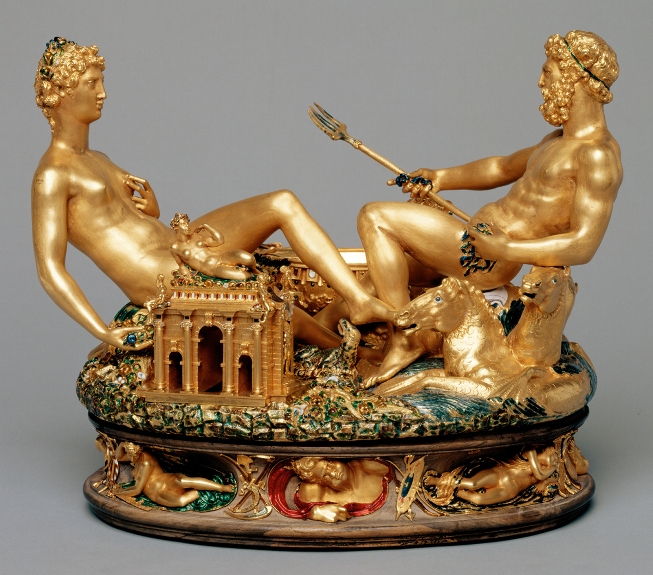
Francis I brought Italian Renaissance influences to the french court, and established a tradition within France that runs through to the present time, of classical styles and triumphalism. He brought to France Benvenuto Cellini as his goldsmith and this section includes reference to and a description of his famous salt cellar. Frances I transformed the Chateaux of Fountainbleu, a hunting lodge into an Italianate palace although with many distinctly French architectural features. Its decoration includes work by the Florentine painter Rosso Fiorentino. 'In few other countries would the nation-state come to be so boldly identified, by its rulers, with the grandeur of ancient Rome'. (p.305) Napoleon and his Arc d'Triomph, Francois Mitterand and his glass pyramid at the Louvre and the huge Arch de la Défense. 'But there is a sense in which the country's political leaders have never grown out of it' (p.305)
Benvenuto Cellini Salt Cellar of Francis I 1540-43
Little Italy
Little of the Italian Renaissance can be found in Britain, although Henry VIII sought in some ways to match his French rival Francis I. The work mentioned is the tomb of Henry VII and his wife Elizabeth of York in Westminster Abbey created by Pietro Torrigiano, an artist who had broken the nose of Michelangelo in a fist-fight in Florence. Britain was separated from Italy by the Reformation and its Protestant religion, although it was influenced by the Northern European Renaissance.
'Let Division Be Made'
This section examines Hans Holbein's painting The Ambassadors describing it as '...the pictorial equivalent of a Renaissance nobleman's cabinet, the most precious piece of furniture in the house, a repository of secrets and of special knowledge, reserved only to those who understand the trickery of its construction'. (p.308)
 The section continues to tell us of the identity of the two figures Jean de Dinteville and Georges de Selve, Bishop of Lavaur who found themselves in Britain at the time of the establishment of the Church of England and Henry VIII marriage to Anne Boleyn. A G-D writes 'The objects heaped on to the shelves on which both men rest their elbows symbolize the disarray into which their world had fallen. The various astronomical instruments on the upper shelf of the table in the picture, which include a celestial globe as well as a number of different mechanisms for telling the time by the motions of the sun - a cylindrical shepherd's dial, two quadrants, a polyheral sundial and a torquetum - are all misaligned for use in a northerly latitude. This is unlikely to have been an oversight on the artist's part, since one of his closest friends in London was the astronomer Nikolaus Kratzer. The misaligned instruments are emblems of chaos, of the heavens out of joint - a disharmony to which the lute with a broken string, conventional symbol of discord, also alludes'. (p.309/10) 'The open book immediately below the globe (literally, its subtext) is an apparently innocent work of practical mathematics, Peter Apian's New and Reliable Instruction Book of Calculation for Merchants. But it is open at a most un-innocent page, which begins with the word 'Dividirt' : 'Let division be made'. To those with sharp eyes and the ability to think laterally - or to those let in on the secret by the Dinteville clan in Polissy - this was a reference to the religious schism that was tearing Europe apart in the 1530's. Division was indeed being made'. (p.310/11). The strangest and most unusual feature of the painting is the blur of a skull painted in 'anamorphic perspective' which can only be seen when viewed at the correct angle, and thus taken with the almost hidden crucifix suggests the larger concern of eternal life and the resurrection that will take precedence over these divisions in the world.
'Th' Intertraffique of the Mind'.
As the title indicated there is a consideration of the expansion of European trade with the wider world that brings with it an exchange and a flow of ideas. It is suggested that the new ideas of the Renaissance, the rediscovery of the values of the ancients are now flowing into the everyday culture of the wider Europe. Antwerp is noted as the principle European port and it is through this city that many of these ideas are flowing, particularly with the early printing establishment of Plantin. This section also considers the work of Pieter Breugal the Elder (c.1525/30 - 69), who in his work captures much of the everyday existence of peasant life. Like his more formal fellow artists however, he draws from the ancients, but this time on their satirical, comical tradition, from authors such as Horace and Martial. A G-D observes that 'The humanity that runs right through Renaissance art and literature seems to broaden yet further during the second half of the sixteenth century. This is true of Bruegel, and more so of Shakespeare, gifted with the broadest imagination of any author, prepared to explore the world of the gravedigger as well as the prince, the buffoon as well as the philosopher, the savage as well as the Magus. There is no such thing as a life not worth noticing'. (p.316).
Counter-Reformation
The end of the Renaissance, if there could be such a thing, is probably brought about by the Roman Catholic Council of Trent which set out a manifesto to counter the Reformation. It particularly dictated styles of art that should be used in a religious context, moving against the individual freedoms and artistic licence that artists had taken and developed from the classical styles and ideas. It sought to rid religious art of any link to pagan myths and legends, and 'excessive' nudity. A G-D writes 'The reformers of the 1560's dreamed of doing away with a large part of the Renaissance because they believed it had clouded the Christian picture. What they were attempting to do, in a sense, was to wind the clock back to the very beginnings of the Italian Renaissance. It is as if they were trying to go all the way back to what might be called the innocent Renaissance, the Renaissance of Giotto, Nicola Pisano and his son Giovanni - who had found, in Greco-Roman naturalism, a vocabulary with which to express a new and vivid piety, but who had not fully opened the Pandora's box of antiquity'. (p.318)
Epilogue
A G-D sums up his book and the Renaissance and seeks to pin-point the essence of what was discovered and the legacy this period has left on Western Civilisation as he writes 'But perhaps the most enduring legacy of the Renaissance lies not in any form of revival - whether of classical ideas, or of realistic depiction - but in the new way in which it taught people to think about their own nature'. (p.324). He returns to Donatello's statue of St John the Baptist (1438) 'The miracle is not just the conjuring up of humanity, of the life force or living presence. The miracle lies in the delicacy and precision with which a moment of feeling has been caught - and in the magnitude of the revelation communicated by this capturing of something that seems so fugitive and, at once, so endlessly fascinating. The message forever trembling on the Baptist's lips is the message of the Renaissance itself. What is inside a man can be a whole world'. (p.324).
Thursday, 1 November 2007
Renaissance - Andrew Graham-Dixon Chapter 5.
Light and Liberty
Love at First Sight.
If Florence was the Renaissance capital of sculpture then Venice was the capital of painting. A.G-D writes ' Venetian painters looked at the overlooked. They painted sexual desire. They found new ways of depicting death. They painted the human face with unparalleled sensitivity. They painted landscape, and the fall of light. In painting all of those things, they changed the way in which people thought about painting itself'. (p.224)
This chapter is introduced with the painting by Titian (or Tiziano Vecellio c.1485-1576) Bacchus and Ariadne which captures the moment of love at first sight.

Venice was a republic (a state which continued until its eventual capitulation to Napoleon), and from it's leading aristocrats elected a governing body and a symbolic head of state, the doge. Venetians mistrusted the promotion of self, preferring to belong to corporate groups within their society. In about 1501 Giovanni Bellini painted a head and shoulders portrait of Doge Leonardo Loredan. Here we see the fine robes and hat of office, but the face is almost expressionless, and the individual unglorified.
Another artwork within this section is the equestrian monument of Bartolommeo Colleoni by the Florentine Andrea del Verrochio. This monument to a soldier who served Venice was created as a result of Colleoni's will, and he requested that the monument be positioned outside St. Mark's cathedral. This self-aggrandisement however, did not sit easy with the Venetians, who eventually allowed the statue to be erected at the edge of the city.
The corporate nature of Venice is captured by Gentili Bellini's Procession in the Piazza St. Marco 1496, in which all the participants share an equality in fact looking like clones of each other.
Victor Carpatius Fingebat
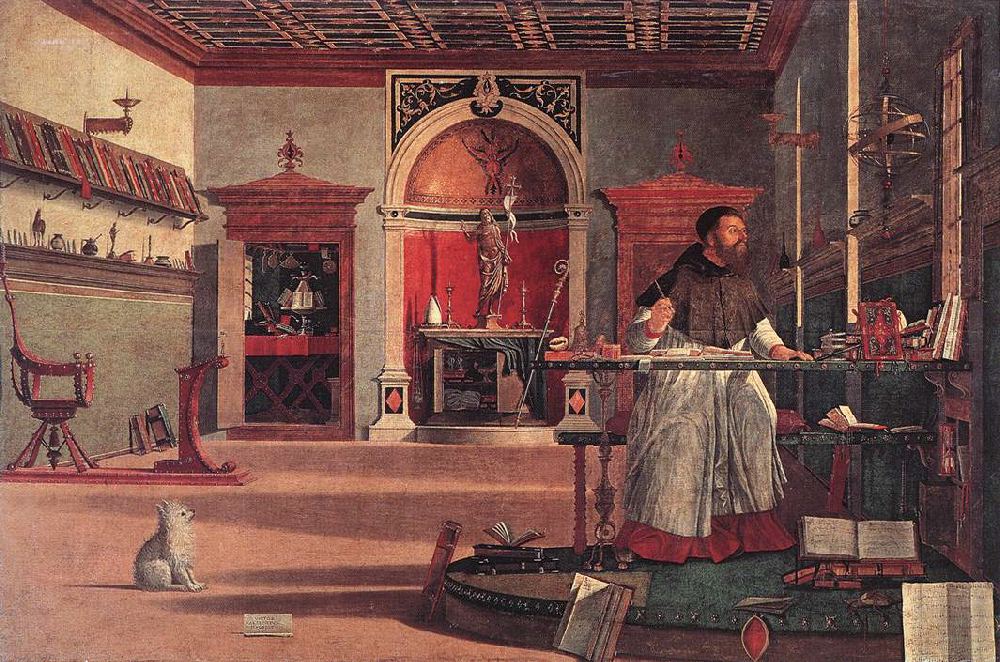
The comporate identity within Venice was encouraged and developed by the various scuola, centres for devotion and debate within the city and the Republic. T he scuola founded by the colony of Dalmatians in Venice in 1451 boasts paintings by Vittore Carpaccio. There is a series of three paintings on the life of St. Jerome including The Vision of St. Augustine c.1502 in which St. Jerome is depicted only as light entering the room and bathing St. Augustine, various objects and his small dog in a naturalistic gentle illumination.
A G-D writes 'This illumination is at once physical and metaphysical, both the light of the everyday world and the light of God. Yet because Carpaccio treated the light naturalisticly, resisting the temptation to place some phantasm of St. Jerome standing in the sun, the gentle glow which bathes the saint's face symbolizes all that we cannot see but can only sense. This light seems to irradiate Augustine from within as well as illuminate him from without, transfiguring him even as it models his features with such objective clarity. Carpaccio signed the picture in Latin, suggesting his own humanistic learning: 'VICTOR CARPATIVS FINGEBAT'. 'Fingebat' not 'pingebat' -created, not painted - as if the artist wanted to hint at his own belief that in making it he had, Leonardo-like, created something magical and even god-like'. (p.236)
Father and Son
The artists workshops in Venice were less competitive that those of Florence, and rather than rejecting what had gone before for something new, sought more to learn from the past and to build upon it. Jacob Bellini one of the unsung heroes of Venetian art was the father of Gentile (1429-1407) and Giovanni (1431/6 - 1516). Jacobo has left two precious albums one in the British Museum, the other in the Louvre which illustrate his own ideas and his wide learning on artistic styles and perspective etc. His two sons built on their fathers foundation, and their work can be seen, Gentile in The Procession in the Piazza St. Marco (as seen above) and Giovanni in his altarpiece The Baptism of Christ. His work recalls that of Leonardo da Vinci, but whereas Leonardo's landscapes display his science and knowledge about the world, Bellini's are more the realms of poetry. Of the 'Baptism' AG-D writes '...it is evident that the picture is not driven by empiricism but by the force of religious emotion'. (p.247)
In Arcadia
In 1505 Giogione painted La Tempesta, a secular landscape which appears linked to the re-emergence in the second half of the 15th Century of the classical literacy genre of the pastoral. In the late 1480's Jacobo Sannazaro had published a pastoral romance called L'Arcadia, which was to influence European literature for the next two hundred years. Both this work and the painting suggest a retreat to the pastoral in the classical and the Renaissance mind alike to a 'lost golden world of untroubled rustic simplicity'. (p.248). Written around 1470 by the Dominican friar Franceco Colonna and printed in 1499 was the pastoral Hypnerotomachia Poliphilli which includes a hundred and sixty-five woodcuts. Part romance, part pastoral, part achitectural fantasy, it seems to take us closer than any other literary source to the meanings of Giogioni's Tempesta. A meditation on the transience of love and all the things of this world. In the lightening and storm in the background 'you may even hear the distant thunder of romanticism'. (p.249)
The Decisive Moment.
This section is primarily about Titian and follows on from the development of the landscape and secular painting. Titian seemed to share a close affinity with the work of Giorgione as can be seen in both their paintings of Venus. Giorgione Sleeping Venus and Titian Venus of Urbino. Titian seems to embody the move of the artist to that of entrepreneur and more than any other artist seems to have created the 'art market'. The buying and collecting of art works saw his work owned by kings, princes and popes. AG-D writes 'More than any other Renaissance artist, he [Titian] shaped the future of painting. Rubens, Poussin, Rembrandt, Veláquez, Watteau, Chardin, Delacroix, Constable, Monet, Degas - all learned to paint in the school of Titian. His painting became the raw material of painting itself'. (p.257)
The Return to the Land
From the mid fifteenth century the Venetians expanded their inland empire with cities such as Vincenza and Padua. In their inland empire know as the Veneto, rich Venetians built a new form of architecture developed by Andrea Palladio (1508-1580). In his architecture a notion gathered momentum that a building might itself be as perfectly formed and as covetable as a work of art. Within these buildings they sought to recreate some of the trompe l'oeil images found in Roman villas. Paolo Veronese (c.1528-88) created such scenes and opened up ceilings into skies and peopled the house with figures.
The Uses of Spectacle
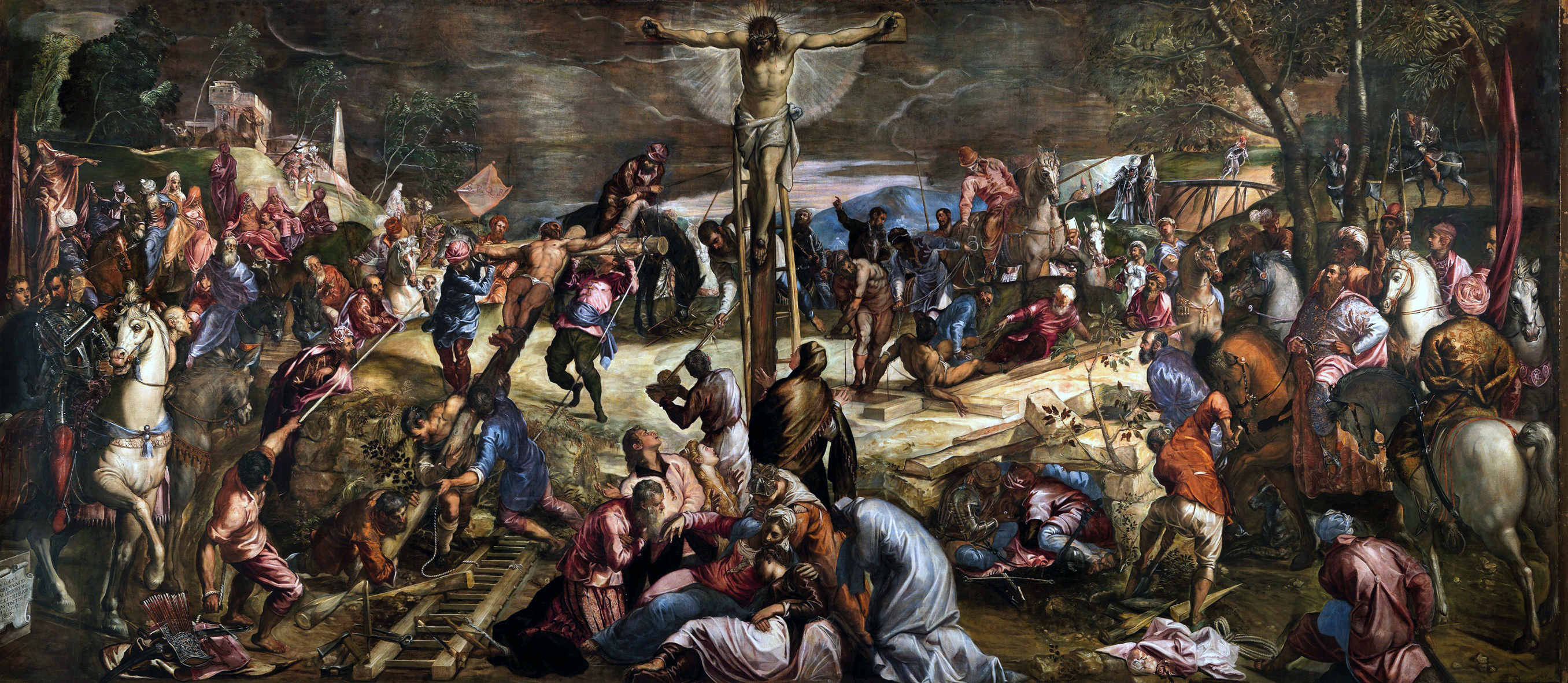
The work of both artists and architects embraced the use of spectacle in the second half of the 16th Century. This featured artists such as Veronese. Increased theatricality can be seen in the paintings of Tintoretto (real name, Jacobo Robusti 1519-94) in his cycle of paintings for The Scuola Grande di San Rocco include his powerful twelve metre wide depiction of the crucifixion.
AG-D writes 'The most engulfing of all Tintoretto's works is the vast billowing vision of Paradise which he and assistants created on the far wall of the Sala del Maggior Consiglio in the Doges' Palace between 1588 and 1592. It is a cauldron of saints, divinities, angels and the blessed. A painting so large that it cannot be taken in at a single glance, a picture which exceeds the range of the human optic, can seem to swirl us into its very structure. This was a truth on which the greatest artists of the Baroque and Rococo would build. But Tintoretto's painting also seems to look forward further in time, to anticipate the panoramic scale of so much modern painting. Jackson Pollock's 'allover' canvases of the 1940's and 1950's - pictures infused perhaps not with a dream of paradise, but with inchoate pantheist yearning - are variations on a Tintoretto theme'. (p.264)
Venice as Idea
The independence of the Venetian artists can be seen typified in the work of El Greco (real name Domenikos Theotokopoulos 1541-1614), who spent some of his formative years in the city. He rejects the styles of Michelangelo, Raphael and others. AG-D writes 'El Greco spent his maturity in Spain but was always, essentially, a painter formed by Venice. He was the first artist of his kind - a moral rather than geographical Venetian, so to speak - but he was only the first of many. Rubens was to be a Venetian living in Antwerp. Delacroix was to be a Venetian living in Paris. Turner was to be a Venetian living in London. By the end of the sixteenth century and perhaps ever afterwards, Venice was no longer a place. It had become an attitude: a state of mind'.(p.165/6)
Pieta
This chapter closes with Titian's Pieta and highlights the divisions between the artists of Rome and Florence who favoured drawing and the Venetians who favoured colour, but concluded that both are part of the same and that 'The power and the depth of painting comes from the fact that it is, indeed, made by man using his hands'. (p.269)
Love at First Sight.
If Florence was the Renaissance capital of sculpture then Venice was the capital of painting. A.G-D writes ' Venetian painters looked at the overlooked. They painted sexual desire. They found new ways of depicting death. They painted the human face with unparalleled sensitivity. They painted landscape, and the fall of light. In painting all of those things, they changed the way in which people thought about painting itself'. (p.224)
This chapter is introduced with the painting by Titian (or Tiziano Vecellio c.1485-1576) Bacchus and Ariadne which captures the moment of love at first sight.
 Built on Mud
A brief history of the founding of Venice and its long association with independence and practical thinking.
Looking Outwards
Built in the lagoon its feet in the sea, Venice is a world of sailors, voyagers and trading, and into the city came the influences from the Byzantine east. 'The multi-racial, market-oriented, outward-looking nature of Venetian Renaissance society - together with its fondness for textures and colours of the bazaar - is reflected in the surfaces of its art'. (p.228/9).
Vittore Carpaccio (c.1460-1525/6) painted a number of pictures telling the story of St. Ursula's life in which he captures the maritime adventure of Venice with successive panorama's of departures and arrivals, richly dressed delegations, ships, pennants and sails swelled by the wind. (Miss Garnet's Angel!!!).
The Cult of Impersonality
Venice was a republic (a state which continued until its eventual capitulation to Napoleon), and from it's leading aristocrats elected a governing body and a symbolic head of state, the doge. Venetians mistrusted the promotion of self, preferring to belong to corporate groups within their society. In about 1501 Giovanni Bellini painted a head and shoulders portrait of Doge Leonardo Loredan. Here we see the fine robes and hat of office, but the face is almost expressionless, and the individual unglorified.
Another artwork within this section is the equestrian monument of Bartolommeo Colleoni by the Florentine Andrea del Verrochio. This monument to a soldier who served Venice was created as a result of Colleoni's will, and he requested that the monument be positioned outside St. Mark's cathedral. This self-aggrandisement however, did not sit easy with the Venetians, who eventually allowed the statue to be erected at the edge of the city.
The corporate nature of Venice is captured by Gentili Bellini's Procession in the Piazza St. Marco 1496, in which all the participants share an equality in fact looking like clones of each other.
Victor Carpatius Fingebat
The comporate identity within Venice was encouraged and developed by the various scuola, centres for devotion and debate within the city and the Republic. T
 he scuola founded by the colony of Dalmatians in Venice in 1451 boasts paintings by Vittore Carpaccio. There is a series of three paintings on the life of St. Jerome including The Vision of St. Augustine c.1502 in which St. Jerome is depicted only as light entering the room and bathing St. Augustine, various objects and his small dog in a naturalistic gentle illumination.
A G-D writes 'This illumination is at once physical and metaphysical, both the light of the everyday world and the light of God. Yet because Carpaccio treated the light naturalisticly, resisting the temptation to place some phantasm of St. Jerome standing in the sun, the gentle glow which bathes the saint's face symbolizes all that we cannot see but can only sense. This light seems to irradiate Augustine from within as well as illuminate him from without, transfiguring him even as it models his features with such objective clarity. Carpaccio signed the picture in Latin, suggesting his own humanistic learning: 'VICTOR CARPATIVS FINGEBAT'. 'Fingebat' not 'pingebat' -created, not painted - as if the artist wanted to hint at his own belief that in making it he had, Leonardo-like, created something magical and even god-like'. (p.236)
Father and Son
The artists workshops in Venice were less competitive that those of Florence, and rather than rejecting what had gone before for something new, sought more to learn from the past and to build upon it. Jacob Bellini one of the unsung heroes of Venetian art was the father of Gentile (1429-1407) and Giovanni (1431/6 - 1516). Jacobo has left two precious albums one in the British Museum, the other in the Louvre which illustrate his own ideas and his wide learning on artistic styles and perspective etc. His two sons built on their fathers foundation, and their work can be seen, Gentile in The Procession in the Piazza St. Marco (as seen above) and Giovanni in his altarpiece The Baptism of Christ. His work recalls that of Leonardo da Vinci, but whereas Leonardo's landscapes display his science and knowledge about the world, Bellini's are more the realms of poetry. Of the 'Baptism' AG-D writes '...it is evident that the picture is not driven by empiricism but by the force of religious emotion'. (p.247)
In Arcadia
In 1505 Giogione painted La Tempesta, a secular landscape which appears linked to the re-emergence in the second half of the 15th Century of the classical literacy genre of the pastoral. In the late 1480's Jacobo Sannazaro had published a pastoral romance called L'Arcadia, which was to influence European literature for the next two hundred years. Both this work and the painting suggest a retreat to the pastoral in the classical and the Renaissance mind alike to a 'lost golden world of untroubled rustic simplicity'. (p.248). Written around 1470 by the Dominican friar Franceco Colonna and printed in 1499 was the pastoral Hypnerotomachia Poliphilli which includes a hundred and sixty-five woodcuts. Part romance, part pastoral, part achitectural fantasy, it seems to take us closer than any other literary source to the meanings of Giogioni's Tempesta. A meditation on the transience of love and all the things of this world. In the lightening and storm in the background 'you may even hear the distant thunder of romanticism'. (p.249)
The Decisive Moment.
This section is primarily about Titian and follows on from the development of the landscape and secular painting. Titian seemed to share a close affinity with the work of Giorgione as can be seen in both their paintings of Venus. Giorgione Sleeping Venus and Titian Venus of Urbino. Titian seems to embody the move of the artist to that of entrepreneur and more than any other artist seems to have created the 'art market'. The buying and collecting of art works saw his work owned by kings, princes and popes. AG-D writes 'More than any other Renaissance artist, he [Titian] shaped the future of painting. Rubens, Poussin, Rembrandt, Veláquez, Watteau, Chardin, Delacroix, Constable, Monet, Degas - all learned to paint in the school of Titian. His painting became the raw material of painting itself'. (p.257)
The Return to the Land
From the mid fifteenth century the Venetians expanded their inland empire with cities such as Vincenza and Padua. In their inland empire know as the Veneto, rich Venetians built a new form of architecture developed by Andrea Palladio (1508-1580). In his architecture a notion gathered momentum that a building might itself be as perfectly formed and as covetable as a work of art. Within these buildings they sought to recreate some of the trompe l'oeil images found in Roman villas. Paolo Veronese (c.1528-88) created such scenes and opened up ceilings into skies and peopled the house with figures.
The Uses of Spectacle
The work of both artists and architects embraced the use of spectacle in the second half of the 16th Century. This featured artists such as Veronese. Increased theatricality can be seen in the paintings of Tintoretto (real name, Jacobo Robusti 1519-94) in his cycle of paintings for The Scuola Grande di San Rocco include his powerful twelve metre wide depiction of the crucifixion.
AG-D writes 'The most engulfing of all Tintoretto's works is the vast billowing vision of Paradise which he and assistants created on the far wall of the Sala del Maggior Consiglio in the Doges' Palace between 1588 and 1592. It is a cauldron of saints, divinities, angels and the blessed. A painting so large that it cannot be taken in at a single glance, a picture which exceeds the range of the human optic, can seem to swirl us into its very structure. This was a truth on which the greatest artists of the Baroque and Rococo would build. But Tintoretto's painting also seems to look forward further in time, to anticipate the panoramic scale of so much modern painting. Jackson Pollock's 'allover' canvases of the 1940's and 1950's - pictures infused perhaps not with a dream of paradise, but with inchoate pantheist yearning - are variations on a Tintoretto theme'. (p.264)
Venice as Idea
The independence of the Venetian artists can be seen typified in the work of El Greco (real name Domenikos Theotokopoulos 1541-1614), who spent some of his formative years in the city. He rejects the styles of Michelangelo, Raphael and others. AG-D writes 'El Greco spent his maturity in Spain but was always, essentially, a painter formed by Venice. He was the first artist of his kind - a moral rather than geographical Venetian, so to speak - but he was only the first of many. Rubens was to be a Venetian living in Antwerp. Delacroix was to be a Venetian living in Paris. Turner was to be a Venetian living in London. By the end of the sixteenth century and perhaps ever afterwards, Venice was no longer a place. It had become an attitude: a state of mind'.(p.165/6)
Pieta
This chapter closes with Titian's Pieta and highlights the divisions between the artists of Rome and Florence who favoured drawing and the Venetians who favoured colour, but concluded that both are part of the same and that 'The power and the depth of painting comes from the fact that it is, indeed, made by man using his hands'. (p.269)
Subscribe to:
Posts (Atom)